
Over time, you start noticing the same competitors consistently doing better, even though nothing about their teams or markets seems dramatically different. They react to change more quickly, adjust their operations sooner, and appear less strained when conditions shift. The reason for this gap rarely lies in capability or motivation, and it is far more often shaped by how work actually flows through the organization and how much friction slows it down along the way.
That friction tends to build gradually as systems are added over time to solve individual problems without ever being designed to work as part of a connected whole. People compensate by manually moving data, double-checking information across tools, and following up on gaps that technology should already handle. Integration platforms and iPaaS solutions are often discussed as technical infrastructure, but their real impact is operational, because they determine how quickly information becomes usable and how easily insight turns into action.
When one organization is still waiting for information to be consolidated, another is already responding to what that information reveals. Over time, this difference becomes embedded in how the business operates, which explains why certain companies continue to outperform others even when effort levels and market conditions appear comparable.
Speed Isn’t Just About Being Fast—It’s About Being First
Speed in business is often confused with working faster or pushing teams harder, when it is really about acting while opportunities still exist and before problems have time to grow. Timing matters because value fades quickly once a window begins to close, whether that window relates to customer demand, market movement, or operational risk.
When early signals of change begin to surface, the organization that can recognize them and respond in time captures value that slower competitors never fully see. The same pattern applies to customer interactions, where issues addressed quickly tend to strengthen trust, while delays introduce frustration that is difficult to undo. These situations are part of everyday business rather than exceptional cases, and they consistently separate companies that lead their markets from those that remain reactive.
What differentiates organizations that arrive first from those that respond late is not intensity or intent, but the ability to move information quickly enough for it to still influence outcomes.
Why iPaaS Integration Creates Unbeatable Speed Advantages
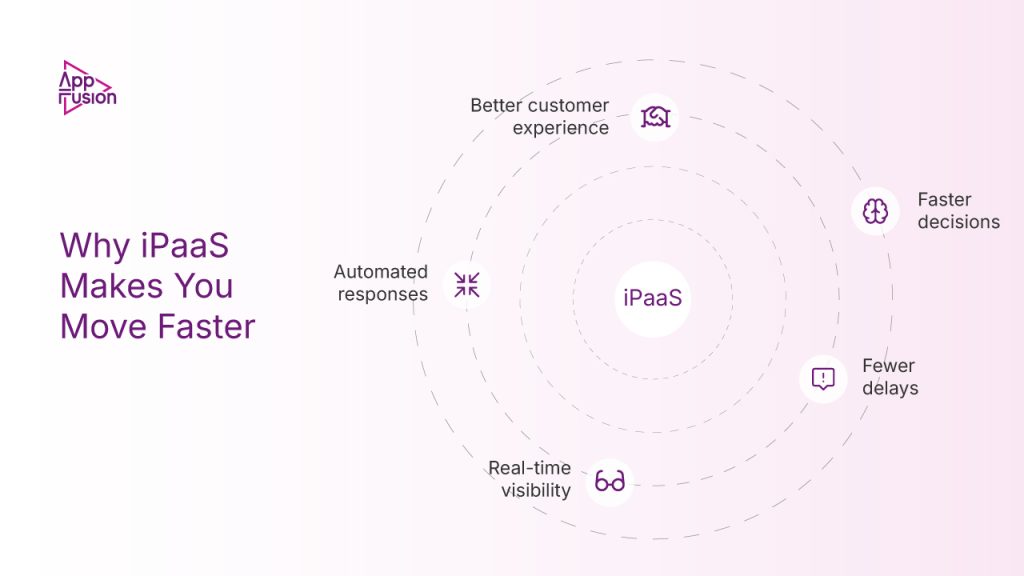
Integration platforms create speed by removing the small delays that accumulate across everyday processes and gradually slow the entire organization. Manual data handling may appear manageable when viewed in isolation, but across multiple systems and teams it introduces friction that compounds over time and limits responsiveness.
Each point where information must be transferred or reconciled manually introduces a pause, and each pause creates uncertainty around accuracy and timeliness. As these pauses become routine, they shape how work is done and what the organization accepts as normal. iPaaS changes this dynamic by allowing systems to share information continuously, reducing the need for people to intervene simply to keep processes moving.
Real-Time Decision Making with iPaaS
In many organizations, decisions are influenced by information that reflects past conditions rather than current reality, largely because gathering and aligning data across systems takes time. By the time insights reach decision-makers, the situation they describe may already have shifted.
Integrated environments change this pattern by making current information available as it is created, which allows leaders to respond while their decisions can still influence what happens next. This shift does not make decision-makers more capable overnight, but it does place them in a position where timing works in their favor rather than against them.
Organizations using iPaaS are not necessarily making better decisions because of superior judgment, but because their decisions are informed by information that reflects what is happening now instead of what happened earlier.
Automated Response to Market Changes
Markets continue to evolve regardless of internal planning cycles or approval processes, and delays between recognizing change and responding to it often determine whether action has any real impact. Integration makes it possible to define responses that occur automatically when certain conditions are met, which removes delays that would otherwise slow the organization down.
Routine actions can move forward immediately, while people focus on decisions that require judgment rather than coordination. This approach preserves momentum without removing human involvement from important decisions.
Customer Experience That Actually Differentiates
Customers experience a business as a single entity, regardless of how many systems or teams exist behind the scenes. When information does not flow properly, the impact becomes visible through delays, repeated requests for the same details, and inconsistent responses that undermine confidence.
When customer data and transactions move smoothly across systems, teams are able to respond with clarity and consistency. Issues are resolved more quickly, follow-ups are more reliable, and customers feel understood rather than passed between processes. Over time, this reliability becomes noticeable, particularly in competitive markets where differentiation is increasingly tied to experience rather than features or pricing.
The result is not just faster service, but a more predictable and dependable interaction that customers remember.
The Hidden Costs of Operating Without iPaaS Integration
While the cost of integration is easy to identify and debate, the cost of operating without it accumulates quietly and often goes unmeasured. Inefficiency becomes accepted as normal, delays are treated as unavoidable, and missed opportunities disappear without ever being recorded.
The Labor Drain You’re Not Tracking
Manual coordination between systems absorbs time from skilled employees and gradually shifts their attention away from work that creates value. Instead of solving problems or improving processes, people spend hours maintaining continuity between tools that were never designed to work together. Over time, this represents a meaningful loss of productive capacity that rarely appears as a single measurable expense, even though it affects performance every day.
As this pattern continues, it also shapes expectations, often lowering the bar for what teams believe is realistically achievable.
Missed Opportunities You Never Even See
Some of the most damaging consequences of slow operations never appear in reports, because they involve opportunities that were never fully realized. When responses take too long, potential deals move elsewhere, partnerships fail to materialize, and market moments pass before action can be taken. These losses are difficult to quantify precisely, but their cumulative effect becomes visible as competitors grow faster and capture more ground.
What iPaaS Integration Actually Looks Like in Practice
Without integration, even simple transactions move through a series of manual steps that introduce delay and risk. Information must be noticed, entered, verified, and passed along before work can continue, which slows progress and increases the likelihood of error.
When systems are connected, the same transactions move automatically from one stage to the next, allowing fulfillment and communication to begin immediately. At scale, this difference reshapes operational capacity and changes what customers come to expect as normal.
Making the Shift: From Cost Center Thinking to Competitive Weapon
Treating integration purely as an IT expense limits its value and often leads to decisions focused on minimizing cost rather than maximizing impact. When integration is viewed as an operational capability, it becomes a way to increase responsiveness, reduce uncertainty, and support growth without requiring teams to work harder to achieve the same results.
This shift in perspective changes how integration is evaluated and how its value is understood across the organization.
The Gap Widens Every Day You Wait
For organizations that have not yet integrated their operations, speed has already become a competitive disadvantage. Companies with integrated systems are able to see change as it happens and respond without waiting for information to move between tools or teams, while others remain constrained by processes that slow decisions and limit timely action.
Integration is no longer simply a technical upgrade pursued for efficiency, but a structural decision about how a business competes. With iPaaS making integration more accessible, continuing to operate with built-in delays increasingly means accepting slower execution in markets where timing plays a decisive role.